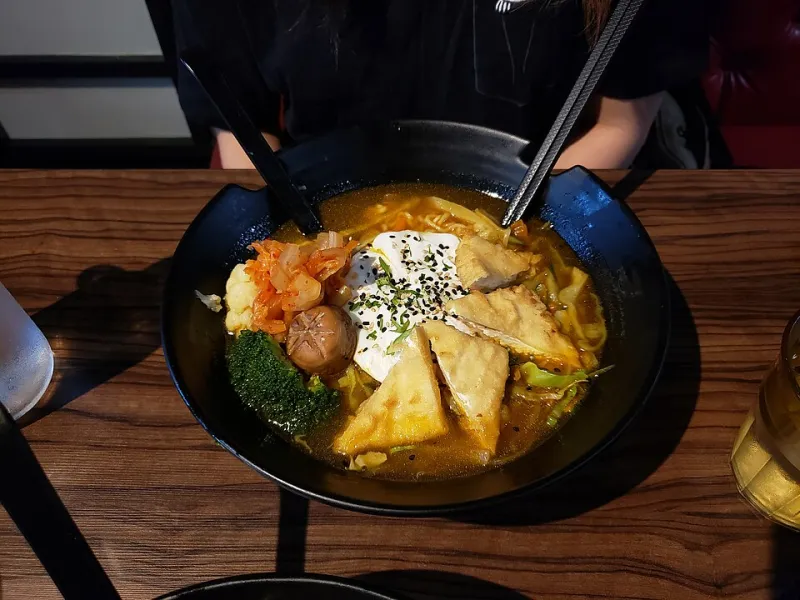
Passport, Chopsticks, and a Google Map Full of Noodle Shops: Inside America's Japan Ramen Pilgrimage
Photo: warabi hatogaya, CC BY 3.0, via Wikimedia Commons
The Flight Isn't About the Sights Anymore
For a lot of Americans, Japan has always been on the bucket list — the temples, the bullet trains, the cherry blossoms. But lately, a different kind of traveler is touching down at Narita or Haneda with a very specific agenda. Their itinerary isn't organized around landmarks. It's organized around bowls.
Call it the ramen pilgrimage. It's real, it's growing, and it's turning ordinary noodle fans into full-on food hunters willing to line up before a shop opens, navigate apps entirely in Japanese, and eat ramen for breakfast without a second thought.
Marcus T., a 34-year-old software engineer from Portland, made his first Japan trip in 2019 specifically to eat at Fuunji in Shinjuku and Menya Musashi in Ikebukuro. "I'd been following ramen accounts on Instagram for two years," he says. "At some point, watching videos wasn't enough. I needed to taste what everyone was talking about."
He's not alone. The overlap between American ramen culture and Japanese travel culture has quietly become one of the more fascinating food tourism trends of the past decade.
How Social Media Turned Japan Into a Noodle Map
Before Instagram and YouTube, serious ramen knowledge in the US was locked behind language barriers and limited to whoever had actually been to Japan. Ramen Jiro, Ichiran, Afuri — these were names you might catch in an obscure food magazine, if you were lucky.
Social media blew that door open. Accounts like Ramen Adventures, Tokyo Ramen Tours, and dozens of Japanese-language creators posting English-subtitled content have essentially built a crowd-sourced guidebook that updates in real time. When a new shop in Tokyo earns buzz, American fans hear about it within days.
Tabelog, Japan's dominant restaurant review platform, has become a kind of sacred text for serious pilgrims even though most of it requires translation tools to navigate. The highest-rated ramen shops on Tabelog — many of which score above 4.0, which is genuinely rare — have become must-visit stops on ramen bucket lists across the US.
"I spent six months on Tabelog before my trip," says Dani R., a food blogger from Chicago who visited Japan in 2023. "I had a spreadsheet. I mapped shops by neighborhood, cross-referenced opening hours, and figured out which ones required reservations versus walk-in lines. It was basically a part-time job."
That level of preparation is more common than you'd think among serious ramen tourists.
Michelin Stars vs. the Underground
The ramen world in Japan splits into two broad camps for pilgrims: the decorated and the hidden.
On one side, you have shops that have earned Michelin recognition — places like Tsuta in Tokyo, which became the first ramen restaurant in the world to receive a Michelin star back in 2016. These spots offer a kind of validation that even non-ramen-obsessed travelers can appreciate. The quality is consistent, the experience is refined, and the story is easy to tell when you get home.
But a lot of the most devoted pilgrims are chasing something harder to pin down. The underground ramen scene — tiny shops run by one or two people, operating limited hours, sometimes only open four days a week — is where obsessives say the real action is. These are places that might have 10 seats and a handwritten menu that changes based on what the chef found at the market that morning.
"Michelin is great, but some of my best bowls have been at shops I found through a Japanese ramen forum that had maybe 200 followers," says Marcus. "There's a place in Sapporo I'm not even going to name because I don't want it to blow up. It's that good."
The tension between accessibility and exclusivity is real. As more American food media covers Japan's ramen scene, the lines at once-hidden shops get longer and the experience changes. It's the same gentrification problem that affects every food culture when it goes global.
What Actually Makes These Trips Worth It
So what do you actually get from flying 14 hours to eat noodles that you can't get from a good ramen shop in LA or New York?
Honestly? Quite a bit.
The density of great ramen in Japanese cities is unmatched anywhere in the world. In Tokyo alone, there are thousands of ramen shops, and even a mediocre one is often better than the best bowl available in most American cities. The ingredients are different — the water, the flour, the pork and chicken breeds, the soy and miso varieties. The chefs have often trained for years under masters before opening their own places. The culture around ramen in Japan treats it with the same seriousness Americans might reserve for fine dining.
And then there's the experience of eating in the shop itself. Many Japanese ramen restaurants use ticket vending machines at the door, which feels alien and delightful the first time. Some are solo-seating setups with wooden dividers, designed so you can focus entirely on the bowl in front of you. That level of intentionality around the act of eating ramen is genuinely hard to replicate anywhere else.
Practical Notes for Your Own Pilgrimage
If you're thinking about making the trip, a few things worth knowing before you go:
Timing matters more than you think. Many top ramen shops in Japan close once they sell out for the day. Some open at 11am and are done by 2pm. Show up at noon expecting a leisurely lunch and you might find a locked door. Check hours obsessively, and plan to arrive early.
Google Translate is your best friend. Most smaller shops won't have English menus, but pointing your phone camera at a ticket machine and letting the app translate works surprisingly well. Don't let the language barrier scare you off the less-touristy spots.
Ramen Nagi, Ichiran, and Ippudo are fine, but don't fill your whole trip with chains. These are great entry points, but if you're flying from the US, push yourself to seek out the independent shops that made Japan's ramen culture what it is.
Tabelog and Ramen Database (ramendb.supleks.jp) are the tools serious pilgrims use. Both are in Japanese, but both can be navigated with a little patience and a translation tool. The ratings are more trustworthy than most English-language guides.
Build in recovery time. Eating ramen twice a day for a week is a real thing people do, but your body will have opinions about it. Pace yourself, drink water, and don't sleep on the lighter broths — a good shio (salt-based) ramen is a welcome break from heavier tonkotsu.
The Bowl at the End of the Journey
What keeps drawing Americans back to Japan for ramen isn't just the food, though the food is extraordinary. It's the feeling of being inside a culture that has taken something as simple as noodles in broth and treated it with complete seriousness for generations.
There's a word in Japanese — kodawari — that roughly translates to an obsessive commitment to craft and detail. You feel it in every bowl at the shops worth seeking out. The broth that took 18 hours. The noodle gauge calibrated to the specific viscosity of the soup. The chashu pork that's been marinated and cooked with care that borders on the spiritual.
When you've tasted that, the pilgrimage makes complete sense.
And when you get home, you'll probably start planning the next one before the jet lag wears off.