Hooked on the Bowl: The Real Science Behind Why You Can't Stop Craving Ramen Broth
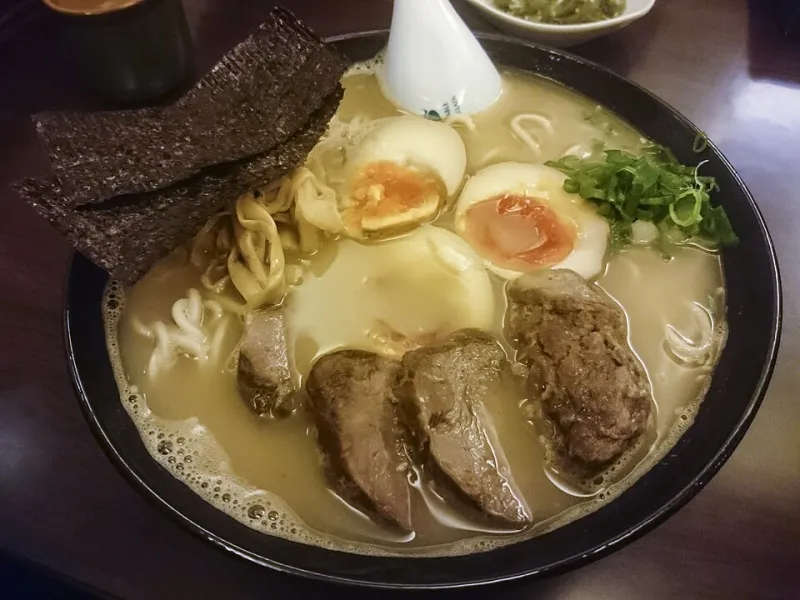
Photo: 迷惘的人生, CC BY-SA 2.0, via Wikimedia Commons
You told yourself one bowl would be enough. It never is.
There's something about a really good ramen broth — the kind that clings to your lips and sits warm in your chest long after the last noodle is gone — that doesn't behave like ordinary food. It lingers. It calls you back. And if you've ever found yourself two days later, mid-afternoon, already mentally negotiating the logistics of another visit, you're not alone. You're also not imagining things.
The craving is real. And it has a mechanism.
Glutamate: The Chemical That Started It All
At the center of this whole conversation is glutamate — specifically, free glutamate, the amino acid responsible for what we call umami. Umami is often described as a "fifth taste," a savory depth that doesn't fit neatly into sweet, sour, salty, or bitter. But that description undersells what's actually happening on a neurological level.
When glutamate binds to taste receptors on your tongue, it doesn't just register as flavor. Research published in neurogastroenterology journals suggests that umami stimulation activates the same dopaminergic reward pathways that light up in response to sugar and fat. In plain terms: your brain treats a deeply umami-rich broth a little like a reward. It wants more. It remembers where it got it.
Monosodium glutamate — MSG — is the purified, crystalline form of this compound, and it's been a quiet staple of ramen kitchens for over a century. Japanese chemist Kikunae Ikeda first isolated glutamate from kombu seaweed back in 1908, and the food industry never looked back. In a ramen shop, MSG might be added directly to the tare (the seasoning concentrate), or it might arrive naturally through the broth-building process itself.
"Honestly, a lot of cooks who say they don't use MSG are absolutely using it," says one ramen chef who asked to remain anonymous. "Every time you reduce a chicken carcass for six hours, every time you steep kombu in hot water, you're liberating free glutamate. The molecule doesn't care whether it came from a factory bag or a pot of bones."
The Broth Is Basically a Glutamate Delivery System
Here's where it gets genuinely fascinating from a food science standpoint. The traditional methods used to build ramen broth — long simmers, collagen breakdown, layering of fermented seasonings — are essentially optimized, through centuries of culinary refinement, to maximize free glutamate concentration.
Take tonkotsu, the creamy pork bone broth synonymous with Fukuoka-style ramen. The extended high-heat boil doesn't just extract collagen (which gives the broth that silky, lip-coating texture). It also breaks down proteins into their constituent amino acids, including glutamate. Simultaneously, the emulsification of bone marrow fat creates a mouthfeel that amplifies how intensely you perceive those umami signals. Fat, it turns out, doesn't just taste good on its own — it acts as a kind of flavor amplifier, slowing down how quickly taste compounds leave your palate and giving glutamate more time to do its thing.
Kombu adds another layer. Dried kelp is extraordinarily rich in glutamic acid, and when it's steeped in warm water — the technique used to make dashi, a foundational Japanese stock — it releases that glutamate freely into the liquid. Combine dashi with katsuobushi (dried fermented tuna flakes, which are high in inosinate, a compound that synergizes with glutamate to multiply perceived umami intensity) and you've got a broth that hits your receptors harder than either ingredient would alone.
Food scientists call this synergy. Ramen chefs just call it "the good stuff."
Intentional Engineering or Happy Accident?
So here's the uncomfortable question: are ramen chefs deliberately engineering addiction into their bowls, or is this just what happens when you cook with great ingredients the traditional way?
The honest answer is probably both, depending on who's behind the stove.
Some chefs are deeply intentional about it. Certain high-volume ramen chains in Japan — and increasingly in the US — have food scientists on staff who analyze glutamate levels in broths and adjust tare formulations to hit specific flavor thresholds. They're not ashamed of this. They see it as craft applied rigorously.
But plenty of independent ramen shop owners in cities like Los Angeles, New York, and Chicago will tell you they're just following the recipes they learned, trying to honor the techniques passed down through apprenticeships. The addiction, in their view, is a byproduct of doing things right — not a goal in itself.
"I'm not trying to trap anybody," laughs one Chicago-based chef who trained in Sapporo before opening his own shop stateside. "I'm just trying to make broth that tastes the way I remember it tasting when I was learning. If people want to come back every week, I take that as a compliment."
The MSG Myth Is Still Alive (And Still Wrong)
It would be irresponsible to talk about umami and glutamate without addressing the elephant in the room: the deeply persistent, thoroughly debunked idea that MSG is harmful. "Chinese Restaurant Syndrome" — the cluster of symptoms some diners claimed to experience after eating MSG-heavy food — has been studied extensively, and the scientific consensus is clear. There is no credible evidence linking MSG consumption to adverse health effects at normal dietary levels. The FDA classifies it as generally recognized as safe.
What's particularly ironic is that many people who claim sensitivity to MSG have no reaction when it's administered in a blind test. Meanwhile, they're happily eating parmesan cheese, ripe tomatoes, and soy sauce — all naturally high in free glutamate — without a second thought.
The stigma around MSG has its roots in xenophobia as much as science, and the ramen community has been pushing back against it for years. Understanding that glutamate is glutamate, regardless of its source, is actually essential to understanding why ramen broth works the way it does.
So Should You Be Worried?
Probably not. The "addiction" in question isn't chemical dependency in any clinical sense — your body isn't going to go into withdrawal if you skip ramen for a week (even if it feels that way). What you're experiencing is a learned preference reinforced by a genuinely powerful sensory experience. Your brain filed the bowl under "extremely good" and now it keeps checking the folder.
That's not a trap. That's just excellent food doing what excellent food is supposed to do.
The deeper takeaway here is that ramen broth — at its best — represents thousands of years of intuitive food science. Long before anyone isolated glutamate in a lab, Japanese cooks were combining ingredients and techniques that happened to maximize umami synergy. The neuroscience caught up later. The craving was always there.
Next time you're halfway through a bowl and already thinking about when you can come back, maybe just lean into it. Your brain knows what it found. There's no shame in listening.