The Bowl That Changed Everything: Ramen Converts Tell Their Stories
Every ramen devotee has a before and an after.
The before is usually embarrassing in retrospect — the brick of dried noodles, the foil flavor packet, the dorm room kettle. Ramen as fuel, not food. Ramen as a punchline about being broke. The before is so universal that it almost functions as shared cultural shorthand: of course you used to think ramen was that. Everyone did.
The after is harder to describe, and that difficulty is part of what makes it interesting. Something happens in front of a real bowl — a bowl with broth that took sixteen hours and a specific philosophy to build, noodles cut to a specific width for a specific reason, toppings arranged with a care that borders on the ceremonial — and the category collapses. The word ramen stops meaning one thing and starts meaning something much larger.
These are the stories of people who crossed that line. They don't come from food-obsessed backgrounds. They weren't looking for a revelation. They just ended up in front of the right bowl at the right moment, and it got them.
"I Thought It Was a Joke"
Marcos, a construction project manager from San Antonio, was dragged to a ramen shop by his college-age daughter during a visit to Austin. He was skeptical in the way that people who grew up eating slow-cooked brisket and handmade tamales are skeptical of things with Japanese names and twenty-dollar price tags.
"I remember thinking, okay, this is going to be one of those food things she's into," he says. "I was planning to be polite."
He ordered a tonkotsu because his daughter pointed at it. The broth arrived looking like something between milk and cream, dense and opaque, with a layer of fat shimmering on the surface. He ate it the way you eat something you're not sure about — cautiously, with a fork he asked for specifically.
He finished the bowl in about eight minutes. Then he sat quietly for a moment.
"I asked her if we could order another one," he says. "She said she'd never seen me do that before."
He's been to four different ramen shops since then. He has opinions about noodle thickness now. He describes this development as "alarming."
The Thing Nobody Warned Her About
Denise grew up in rural Mississippi, in a household where soup meant either gumbo or something her grandmother made from a can. Japanese food was abstract — not something that existed in her daily reality, not something she'd been taught to approach with curiosity or suspicion. It was simply elsewhere.
She encountered ramen for the first time at a shop in Nashville, where she'd moved for work in her late twenties. A coworker picked the place. Denise ordered what her coworker ordered because she didn't know how to read the menu.
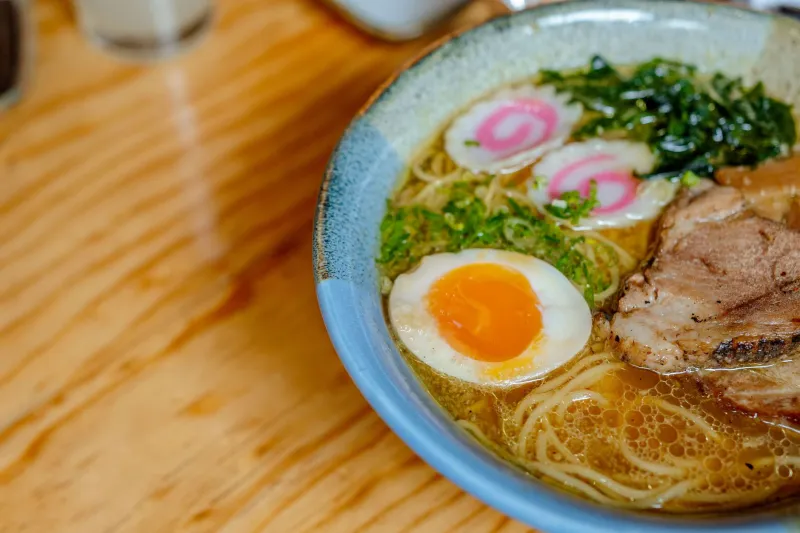
What arrived was a shoyu broth bowl — clear, amber-colored, deeply savory in a way she didn't have words for yet. The noodles were springy. There was a soft-boiled egg cut in half, its yolk still jammy and orange at the center, that she ate first almost accidentally.
"Nobody told me it would taste like that," she says. "I don't even know how to explain what 'that' is. It just tasted like something that had been thought about very carefully."
She's been back to that shop eleven times. She's tried six different bowls. She has a favorite, and she orders it when she needs to feel like things are under control. That's a specific thing ramen does for people, and she didn't expect it.
The Guy Who Didn't Think He Liked Soup
There's a category of ramen convert that shows up more often than you'd expect: people who didn't think they liked soup. Not people who disliked Japanese food specifically, or who had bad experiences with noodles, but people who had genuinely concluded that broth-based dishes weren't for them.
Kevin, a software developer from Minneapolis, was one of them. He'd spent most of his adult life eating in ways that centered texture and substance over liquid — steaks, sandwiches, things with crunch. Soup felt thin to him. Incomplete.
He ended up at a ramen shop because a work lunch went sideways and it was the only place with available seating. He ordered a miso ramen because it sounded the most substantial, and he was prepared to be underwhelmed.
The bowl that arrived was a Hokkaido-style miso, heavy with butter and corn, the broth thick enough to coat a spoon. The noodles were wavy and dense. There was a slab of chashu pork that had been torched at the edges.
"It didn't feel like soup," he says. "I don't know what it felt like. It felt like a meal that had been compressed into a bowl somehow."
He now has a ramen blog. He is sheepish about this but not apologetic.
What the Conversion Actually Is
Listen to enough of these stories and a pattern emerges. The conversion isn't really about ramen. It's about the discovery that something you thought you understood — a category, a cuisine, a type of food — was actually a closed door you'd never tried to open.
Ramen is uniquely good at forcing that door open because it arrives looking like something familiar and reveals itself as something else entirely. The gap between instant noodles and a properly made bowl of tonkotsu is one of the largest category gaps in food. Crossing it produces a specific kind of shock — the pleasant disorientation of realizing your map was wrong.
That shock tends to generalize. People who have their ramen moment often report that it changed how they approach unfamiliar food more broadly — with more curiosity, less assumption, more willingness to be surprised.
A bowl of noodles that teaches you to keep your mind open. That's not a small thing.
The Before Doesn't Disappear
Here's something the converts are mostly unanimous about: they don't feel embarrassed about the before. The packet ramen, the dorm room kettle, the years of not knowing — none of it reads as a failure in retrospect. It was just where they were.
The before is actually part of what makes the after feel significant. If you'd grown up knowing what ramen could be, the first real bowl would be confirmation. Instead, for most Americans, it's a revelation — and revelations, by definition, require some amount of darkness to work in.
The bowl finds you when it finds you. And when it does, you tend to remember it.